

Table of Contents
- Understanding Light Glare and Spill in Garden Lighting
- Landscape Lighting Glare Control Techniques
- How to Position Garden Lights to Avoid Glare
- Top 10 Anti-Glare Garden Lighting Solutions
- 1. Hunza Spike Spot PureLED with Glare Guard
- 2. CLA Lighting Mestolo Exterior Anti-Glare Spike Lights
- 3. Lucretia Lighting Anti-Glare LED In-Ground Light
- 4. CLA Lighting Phare Outdoor Garden Anti-Glare Spike
- 5. Elipta Glare Shield 48mm Accessory
- 6. Havit Tivah TRI Colour LED Garden Spike Light
- 7. Bondilights Slim Bollard Range
- 8. Allera Light Glare Guard for Spike Lights
- 9. Haneco PARX G2 Glare Cover
- 10. Professional Design and Installation Service
- Outdoor Lighting Installation Standards Australia
- Common Mistakes to Avoid When Installing Garden Lights
- Conclusion
Last Updated: August 9, 2026
Understanding Light Glare and Spill in Garden Lighting
Garden lighting transforms outdoor spaces after dark, but poorly positioned or unshielded lights create glare that ruins the atmosphere they’re meant to enhance. Best garden lighting for glare control begins with understanding how light behaves: direct, unobstructed light sources cause discomfort and reduce visibility, whilst properly shielded fixtures distribute illumination evenly without harsh spots or shadows.
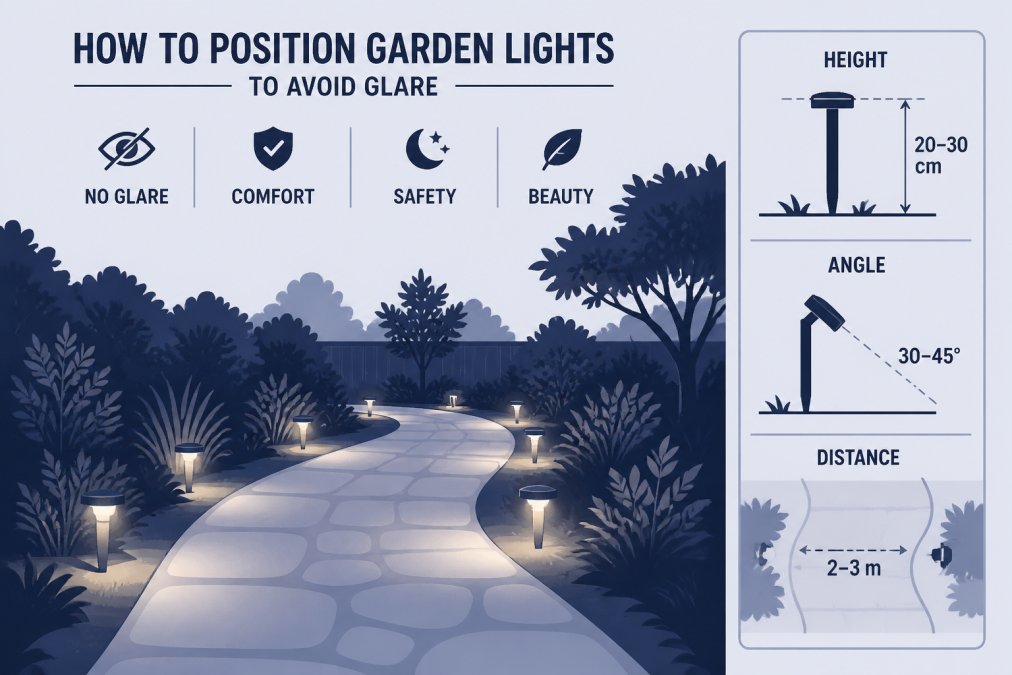
Light glare occurs when a bright light source enters your field of vision directly or reflects off surfaces. In garden settings, this happens when spike lights or floodlights sit at eye level without diffusion, or when beam angles are too wide for the space. Spill refers to light escaping beyond the intended area, shining into neighbours’ windows or onto the street. Both problems are solvable with the right hardware and placement strategy.
At WaterPro’s, we’ve spent over three decades designing garden lighting systems that eliminate glare whilst enhancing landscape features. The difference between uncomfortable, harsh lighting and welcoming ambient illumination comes down to three factors: fixture selection, beam angle, and physical positioning.
Glare isn’t inevitable, it’s a design choice. The fixtures you select and how you position them determine whether your garden feels inviting or harsh.
Landscape Lighting Glare Control Techniques
Controlling glare requires a multi-layered approach combining fixture selection, colour temperature adjustment, and strategic placement. This is where landscape lighting glare control separates professional installations from amateur attempts.
Choosing the Right Colour Temperature
Colour temperature, measured in Kelvin (K), dramatically affects how your eyes perceive light and whether glare becomes noticeable. Warm white light (2700K-3000K) appears softer and less harsh than cool white (5000K+), even at the same brightness level. Warm light has longer wavelengths that scatter more diffusely, whilst cool light concentrates more intensely on the retina.
For garden spaces where people relax or move through pathways, warm white lighting reduces glare perception and creates an inviting atmosphere. Most residential gardens benefit from 2700K-3000K warm white LEDs, particularly for spike lights and bollards positioned along pathways.
If you’re retrofitting existing lights, upgrading the globe to a warm white LED often reduces glare perception without replacing the entire fixture.
Selecting Appropriate Beam Angles
Beam angle, the width of light spread from the source, is one of the most overlooked glare variables. A 60° beam angle floods a large area with light, increasing spill and glare. A 24° or 36° beam angle concentrates light where it’s needed, reducing unwanted illumination and harsh brightness.
Narrow beam angles (15°-24°) suit accent lighting on specific features like trees or sculptures. Medium angles (36°-48°) work for pathway lighting and general landscape illumination. Wide angles (60°+) are rarely appropriate for residential gardens. The narrower your beam, the more control you have over where light goes, directly reducing glare and spill.
How to Position Garden Lights to Avoid Glare
Placement determines whether a fixture becomes a glare source or a subtle design element. This is where how to position garden lights to avoid glare becomes practical: the same light can be uncomfortable or invisible depending on where it sits relative to viewing angles.
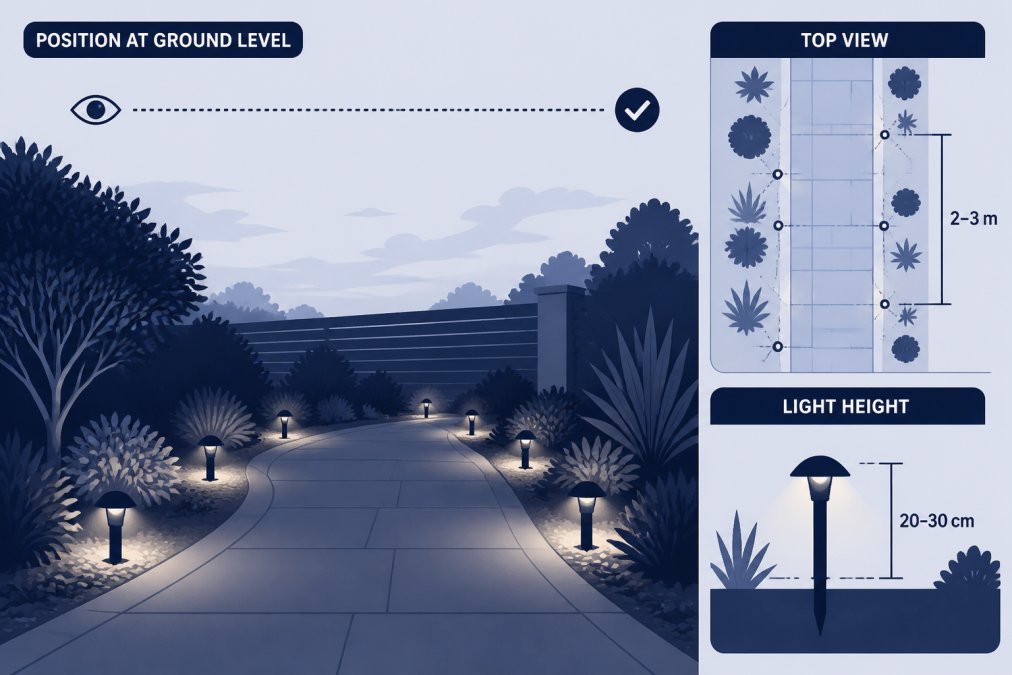
The golden rule is simple: position lights below eye level whenever possible. A spike light at ground level pointing upward at a tree creates accent lighting without directly hitting your eyes. Bollards work because they’re designed to sit 300-600mm high, below the typical standing eye level of 1600mm.
When uplighting is necessary, shield the light source itself. Use cowls, eyelid covers, or honeycomb louvres that conceal the bright LED whilst allowing shaped light through. This prevents direct view of the light source, the primary cause of glare, whilst maintaining the illumination you want.
Strategic Placement for Hardscape and Softscape
Hardscape elements (paving, decking, stone walls) reflect light more intensely than softscape (plants, mulch, grass). Position lights to graze across surfaces rather than directly illuminate them, and consider surface colour when planning placement. For softscape, position lights to silhouette plants or create shadow play rather than washing them in direct light. This approach uses less brightness, reduces glare, and creates more interesting visual effects.
Low-Voltage and Smart Automation Benefits
Low-voltage systems (12V) offer practical advantages beyond safety. Lower voltage allows for thinner cables, easier installation, and the ability to run lights longer distances without voltage drop. Low-voltage LED fixtures often include integrated diffusers and glare guards that mains-voltage alternatives lack.
Smart automation lets you adjust brightness based on time and activity. Evening entertaining might call for 100% brightness, whilst late-night navigation needs only 30%. Dimming reduces glare perception and energy use simultaneously.
Homeowners wanting flexible lighting that adapts to different times and activities without rewiring or replacing fixtures.
Top 10 Anti-Glare Garden Lighting Solutions
1. WaterPro’s Professional Garden Lighting Design and Installation Service
The most effective anti-glare solution is professional design paired with installation expertise. WaterPro’s offers free garden lighting design consultation tailored to your property’s layout, viewing angles, and neighbour proximity. Our qualified technicians assess your space, recommend appropriate fixtures, and position lights to eliminate glare whilst achieving your aesthetic goals.
With over three decades of hands-on experience, we’ve learned that glare problems almost always stem from fixture selection, beam angle mismatch, or poor placement. Our service includes site-specific recommendations for colour temperature, beam angles, and positioning that prevent glare before installation.
Most glare complaints arise from installations completed without considering viewing angles from adjacent properties. Professional assessment identifies these sightlines before installation.

2. Hunza Spike Spot PureLED with Glare Guard
The Hunza Spike Spot represents premium anti-glare spike lighting. Machined from aluminium, solid copper, or 316 stainless steel, it’s built for harsh Australian conditions. The key feature is the optional glare guard, a shield that conceals the light source from direct view whilst allowing controlled light through.
The fixture includes 360° rotation and 90° tilt, letting you aim light precisely at garden features. Available with MR16 LED or Hunza’s own PureLED module, it handles multiple beam angles. The IP66 rating means it withstands dust and high-pressure water without degradation.
3. CLA Lighting Mestolo Exterior Anti-Glare Spike Lights
The Mestolo integrates anti-glare design into the fixture itself rather than as an add-on accessory. Fixed at a specific angle, it’s designed to direct light downward and outward without exposing the LED directly to eye level. Available in aged brass and matte black finishes, it suits contemporary garden aesthetics.
At 12V low voltage, it integrates easily into existing systems. The IP65 rating handles Australian weather. Best for pathway lighting and garden bed illumination where you don’t need to adjust aiming after installation.
4. CLA Lighting Phare Outdoor Garden Anti-Glare Spike Light
The Phare combines adjustability with integrated glare control through a clear acrylic diffuser. Unlike bare LED spike lights that create harsh shadows, the diffuser spreads light more evenly whilst reducing the bright-spot effect. The repositionable spiked rod lets you adjust placement and angle after installation.
Available in titanium, matte black, and 316 stainless steel, it suits various garden styles. The 12V low-voltage design and IP65 rating make it practical for most Australian gardens.
5. Lucretia Lighting Anti-Glare LED In-Ground Light
For subtle, recessed lighting, the Lucretia in-ground light excels. Installed flush with paving or garden edges, it’s nearly invisible during the day. The honeycomb louvre inside the fixture provides excellent glare control; the light source is completely concealed, and only shaped light emerges.
Multiple beam angle options (15°, 24°, 36°) let you control exactly where illumination goes. The IP67 rating means it handles wet conditions without failure. Colour temperature options range from warm white (2700K) to cool white (5000K).
6. Havit Tivah TRI Colour LED Garden Spike Light
The Tivah offers flexibility through colour-changing capability. Three colour temperature settings (warm, neutral, cool white) let you shift the mood without changing fixtures. The adjustable head directs light precisely, and the LED technology ensures energy efficiency.
This suits homeowners who want different lighting moods for different occasions. The trade-off: colour-changing lights are more complex than fixed-colour alternatives.
7. Bondilights Slim Bollard Range
Bollards are inherently low-glare because they sit below eye level by design. Bondilights’ Slim Bollard Range takes this further with custom-tailored height, recessed LED chips, and angled faceplates that direct light downward without exposing the source. Built from 316-grade stainless steel, solid brass, or solid copper, they withstand Australian coastal and inland conditions.
The warm white colour temperature (2700K-3000K) creates inviting pathway lighting without harsh brightness. Best for driveways, pathway edges, and garden perimeters where ambient, low-level lighting is the goal.
8. Allera Light Glare Guard for Spike Lights
If you already own Allera Light Lotus or Willow spike lights, the glare guard accessory adds shield functionality without replacing the entire fixture. Made from durable machined aluminium, anodised and twice powder-coated, it attaches with two grub screws and requires no modification to the original light.
The shield conceals the light source from direct view, reducing glare significantly. For retrofitting existing installations, this is a cost-effective solution.
9. Elipta Glare Shield 48mm Accessory
Similar to the Allera guard, the Elipta Glare Shield fits specific Elipta spotlight models (EP4836 Spike8). Made from anthracite anodised aluminium, it conceals the light source and improves aesthetic appeal.
Compatible only with Elipta’s own fixtures, it’s a retrofit option for existing installations.
10. Haneco PARX G2 Glare Cover
For larger outdoor areas requiring powerful floodlighting, the Haneco PARX G2 glare cover reduces glare from high-intensity lights. Compatible with multiple PARX models (75W, 150W, 200W, 300W), it significantly reduces unwanted glare whilst maintaining effective illumination.
Mounts on the top or bottom of the fixture, offering installation flexibility. Designed for harsh environments, it’s durable and long-lasting.
| Solution | Type | Best For | Glare Control Method | Adjustment |
|---|---|---|---|---|
| WaterPro’s Professional Service | Design & Installation | Comprehensive solutions tailored to your property | Expert placement + fixture selection | Fully customised |
| Hunza Spike Spot | Spike Light | Accent lighting on featured plants/structures | Optional glare guard accessory | 360° rotation, 90° tilt |
| CLA Mestolo | Spike Light | Pathway and garden bed lighting | Integrated fixed anti-glare design | Fixed angle |
| CLA Phare | Spike Light | Flexible pathway and feature lighting | Acrylic diffuser | Repositionable spike |
| Lucretia In-Ground | Recessed Light | Subtle paving and edge illumination | Honeycomb louvre, recessed source | Multiple beam angles |
| Havit Tivah | Spike Light | Mood-adjustable accent lighting | Adjustable head + colour options | Adjustable, colour-changing |
| Bondilights Bollard | Bollard | Driveway and pathway perimeter lighting | Below-eye-level design + recessed chips | Custom height |
| Allera Glare Guard | Retrofit Accessory | Existing Allera spike light upgrades | Shield conceals source | Bolt-on |
| Elipta Shield | Retrofit Accessory | Existing Elipta spotlight upgrades | Shield conceals source | Bolt-on |
| Haneco PARX Cover | Floodlight Cover | Large-area outdoor illumination | Reduces glare from high-intensity lights | Top or bottom mount |
Outdoor Lighting Installation Standards Australia
Australian garden lighting installations must comply with the Electrical Safety Act 2016 (Victoria) and relevant Australian Standards, particularly AS/NZS 3000 (Electrical installations). Low-voltage systems (12V) are safer than mains-voltage alternatives, but they still require proper installation to avoid hazards.
Key standards address IP ratings (dust and water protection), cable sizing, earthing, and weatherproofing. A fixture rated IP65 means it’s dust-tight and protected against water jets, suitable for garden use. IP67 means it can handle temporary immersion. Professional installers understand these standards and design systems that comply with current regulations, protecting your investment and ensuring safety.
Common Mistakes to Avoid When Installing Garden Lights
The most frequent error is positioning lights at eye level without diffusion. A spike light planted in the middle of a garden bed at standing height becomes a glare source immediately. Always position fixtures below typical eye level or shield the source if height is unavoidable.
Choosing beam angles without considering the space is another common mistake. A 60° wide beam on a narrow pathway creates spill and glare. Start with narrower beam angles (24°-36°) and expand if needed.
Overlooking neighbour sightlines causes relationship problems and potential disputes. Before installation, walk to your neighbours’ properties and note where your planned lights will be visible. If a fixture will shine directly into a neighbour’s window, reposition it or add shielding.
Using cool white (5000K+) for ambient garden lighting creates harsher, more noticeable glare than warm white (2700K-3000K). Save cool white for security or task lighting; use warm white for spaces where people relax.
Installing lights without considering voltage drop on long cable runs causes dimming and colour shifts. Professional installation avoids this entirely.
Many DIY installations ignore weatherproofing details. A light that works perfectly for six months then fails because water entered the connection point is a common outcome. Professional installers seal connections, route cables properly, and use outdoor-rated components throughout.
Garden lighting doesn’t have to be harsh or glare-filled. The right fixtures, positioned thoughtfully and paired with proper shielding, create comfortable, beautiful outdoor spaces. WaterPro’s offers free garden lighting design consultation to assess your property’s unique layout and recommend solutions tailored to your needs. Our qualified technicians handle installation to Australian standards, ensuring your system performs reliably for years. Book Now for a consultation and discover how professional design eliminates glare whilst enhancing your garden’s evening appeal.
Frequently Asked Questions
What is an anti-glare shield for outdoor light?
An anti-glare shield is an accessory that reduces or eliminates harsh light directly visible to the eye. These shields, such as eyelid covers, honeycomb louvres, or cowls, conceal the light source while allowing illumination to reach your garden features. They work by blocking the direct beam path, diffusing light instead. Products like the Hunza Spike Spot PureLED and CLA Lighting Mestolo come with built-in anti-glare design, whilst others like the Elipta Glare Shield 48mm attach to existing lights.
How do I choose the right beam angle for my garden lighting?
Beam angle determines how wide your light spreads. Narrow angles (15°-24°) focus light on specific features like trees or sculptures, reducing spill to neighbours. Wide angles (36°+) illuminate larger areas like pathways but increase glare risk. The Lucretia Lighting Anti-Glare In-Ground Light offers multiple beam options (15°, 24°, 36°) to match your landscape. For accent lighting, choose narrow angles; for ambient pathway lighting, wider angles work better with diffusion or shielding.
Should I use warm white or cool white lights to reduce glare?
Warm white (2700K-3000K) is better for reducing perceived glare in gardens. Cooler tones (4000K+) appear brighter and harsher to the eye, increasing glare sensation. Warm white also creates a welcoming atmosphere and is less disruptive to neighbours. Products like the Bondilights Slim Bollard Range use warm white tones specifically to provide gentle illumination without glare. Colour temperature combined with proper shielding and placement gives you the best visual comfort.
What's the difference between spike lights and in-ground lights for glare control?
Spike lights sit above ground and can be repositioned, making them flexible for highlighting features. In-ground lights (recessed into soil or pavement) sit below eye level, naturally reducing glare because the light source is hidden. The Lucretia Lighting Anti-Glare In-Ground Light uses a recessed design with honeycomb louvre for maximum glare control. Spike lights like the CLA Lighting Phare rely on diffusers and shields. Choose in-ground for pathways where glare is critical; spike lights for accent features where repositioning matters.
This article was written using GrandRanker