

Table of Contents
- Why Professional Outdoor Lighting Installation Matters
- Types of Garden Lighting Fixtures and Their Purpose
- Lighting Design and Planning for Your Property
- LED Technology and Energy-Efficient Outdoor Lighting
- IP Rating Requirements for Outdoor Lights
- Outdoor Lighting Installation Cost and Budgeting
- Why You Need a Licensed Electrician for Garden Lighting
- Installation Process and What to Expect
Last Updated: August 12, 2026
Why Professional Outdoor Lighting Installation Matters
Professional outdoor lighting installation transforms how your garden functions after dark. It creates usable outdoor spaces, enhances security, and adds genuine value to your property. When done properly, garden lighting extends your living space and makes your home safer while adding architectural appeal.
The difference between amateur and professional work becomes obvious within weeks. Poorly installed systems create harsh shadows, waste energy, and often fail during heavy rain. Professional installation accounts for your property’s unique layout, climate challenges, and long-term maintenance needs.
At WaterPro’s, we’ve spent over three decades installing garden lighting systems across Melbourne properties. We’ve learned what works in our climate, what fails predictably, and how to design lighting that looks intentional rather than accidental.
The most common mistake homeowners make is treating outdoor lighting as an afterthought. Plan your lighting design alongside your garden layout, not six months after landscaping is complete. Changes are far cheaper during design than after installation.
Types of Garden Lighting Fixtures and Their Purpose
Garden lighting serves different functions, and each requires a different fixture type. Understanding these categories helps you plan a system that actually works for your space.
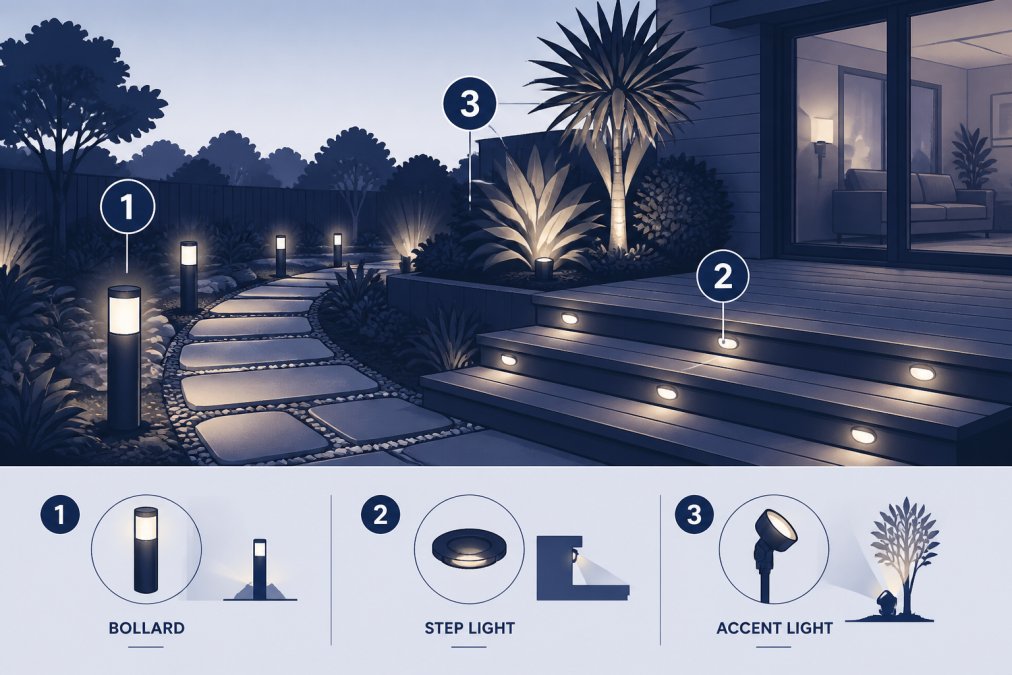
Pathway bollards and deck step lights
Pathway bollards are short posts (typically 30-60 cm high) that line walkways and garden edges. Deck step lights mount directly into or beside steps to illuminate transitions between levels. Both serve the same core function: safe navigation through your garden after dark.
Pathway bollards work best when spaced 1-2 metres apart along routes you actually walk. Step lights are essential wherever there’s a height change, preventing trips and falls on slippery surfaces. These fixtures typically use low-voltage LED bulbs and must be fully weatherproof and rated for outdoor use. Poor-quality pathway lights fail within a season because water infiltrates the housing or wiring corrodes.
Accent and architectural lighting
Accent lighting highlights specific garden features, a mature tree, water feature, sculptural plants, or architectural elements like stone walls or pergolas. This is where garden lighting becomes design-focused rather than purely functional.
Accent lighting works by placing a light source below, beside, or behind a feature to create drama and depth. Uplighting a mature tree creates a striking silhouette. Wash lighting across a stone wall emphasizes texture. Done well, accent lighting transforms your garden’s nighttime appearance. The key is restraint: one or two well-placed accent lights create sophistication, while four or five scattered around create visual chaos.
Security and ambient lighting
Security lighting deters unwanted activity by illuminating entry points, pathways, and darker corners. Motion-activated security lights are common, though always-on security lighting provides more consistent deterrence. Ambient lighting creates overall illumination for entertaining or general evening use, softer than security lighting but more functional than accent lighting.
The distinction matters for installation. Security lights need to eliminate hiding spots and cover entry routes. Ambient lighting can be softer and more distributed. Many properties benefit from both: security coverage for practical safety, plus ambient lighting for atmosphere.
The most effective [garden lighting systems](/blog/landscape-lighting-melbourne-guide/) combine three types: functional lighting for safety (pathway and step lights), accent lighting for visual interest (feature highlighting), and ambient lighting for atmosphere and general use.
Lighting Design and Planning for Your Property
Before any fixture gets installed, your garden needs a lighting plan. This is where professional outdoor lighting installation begins, with understanding your property’s layout, sight lines, and how you actually use your outdoor spaces.
Creating a lighting layout that works
A lighting layout starts with identifying key zones: entry points, main pathways, entertaining areas, and features worth highlighting. Walk your garden at night with a torch and notice where you naturally need light and where shadows create trip hazards.
Professional designers sketch these zones and mark fixture locations on a scaled plan. They consider sight lines from inside your home, from the street, and from neighbouring properties. They identify where light spill might affect neighbours and plan wire routes to minimise visible cables. This planning phase typically takes 1-2 hours for a residential property. WaterPro’s provides free design consultation, assessing your garden and creating a detailed plan before you commit to installation costs.
Climate and seasonal considerations
Melbourne’s climate creates specific lighting challenges. Summer brings intense heat that can damage poor-quality fixtures. Winter brings wet conditions that expose weatherproofing flaws. Your lighting design should account for seasonal shifts: accent lights on deciduous trees work beautifully in winter but may be obscured in summer. Professional designers position lights to remain effective as gardens mature rather than requiring constant repositioning.
LED Technology and Energy-Efficient Outdoor Lighting
LED technology has transformed outdoor lighting economics. Modern LED garden lights use 75-80% less energy than older halogen or incandescent systems, generate far less heat, and last significantly longer.
Low voltage versus mains voltage systems
Low-voltage systems (typically 12V) run through a transformer that steps down mains power. They’re safer to work with, easier to install, and ideal for most residential gardens. Mains voltage systems (240V) run directly from your home’s electrical supply and require licensed electrician involvement.
For most residential properties, low-voltage LED systems deliver everything you need. They’re efficient, safe, and cost-effective. The transformer sits in an accessible location and controls the entire system.
Smart sensors and lighting automation
Modern outdoor lighting systems can include motion sensors, dusk-to-dawn sensors, and smart controls that let you adjust brightness or turn lights on/off from your phone. Motion sensors reduce energy use by lighting only when needed. Smart lighting integration lets you create scenes and adjust settings based on your daily routine.
These features add cost upfront but provide genuine convenience and can reduce energy consumption significantly. They’re particularly valuable for security lighting and entertaining areas where you want flexible brightness control.
Not all outdoor lighting fixtures support smart controls. If automation is important to your plan, specify this during the design phase. Retrofitting smart sensors into existing systems is more expensive than building it in from the start.
IP Rating Requirements for Outdoor Lights
IP ratings define how well a fixture resists dust and water ingress. The rating consists of two digits: the first indicates dust protection, the second indicates water protection. For outdoor lighting, the second digit matters most.
An IP65 rating means the fixture is dust-tight and can withstand low-pressure water jets from any direction. This is the minimum for outdoor garden lighting. IP67 means the fixture can be temporarily immersed in water, suitable for lights near water features. IP68 is fully submersible and used for underwater or fountain lighting.
Outdoor lighting installation code requires fixtures to meet at least IP65. Cheaper fixtures sometimes claim water resistance without proper IP certification and fail predictably when exposed to Melbourne’s winter rain. Always verify the IP rating is printed on the product or packaging.
Outdoor Lighting Installation Cost and Budgeting
Professional outdoor lighting installation cost varies based on system complexity, fixture quality, and labour requirements. Understanding what affects pricing helps you budget realistically.
What affects your installation price
Several factors drive professional outdoor lighting installation cost:
- Number of fixtures – Each light adds labour and materials
- System type – Low-voltage systems cost less than mains voltage; smart-enabled systems cost more than basic fixtures
- Fixture quality – Professional-grade fixtures cost more but deliver better longevity
- Site complexity – Difficult terrain or challenging electrical access costs more
- Transformer location – Difficult placements require longer cable runs
- Weatherproofing – Proper cable protection and sealed connections prevent failures
For specific pricing, contact WaterPro’s for a free design consultation and quote.
Energy efficiency ROI and long-term savings
LED outdoor lighting systems pay for themselves through energy savings over 3-5 years. A typical residential garden lighting system using LED fixtures consumes roughly 50-100 watts when fully lit, comparable to a single incandescent bulb. The same system using older halogen technology would consume 400-600 watts.
LED systems require far fewer bulb replacements. A quality LED bulb lasts 25,000-50,000 hours; a halogen bulb lasts 2,000-3,000 hours. The total cost of ownership, installation, energy, and maintenance, favours LED systems decisively.
Why You Need a Licensed Electrician for Garden Lighting
Garden lighting installation isn’t a DIY task. Outdoor electrical work requires professional expertise, proper certification, and compliance with electrical safety standards.
Electrical compliance and safety standards
In Australia, outdoor electrical work must comply with the Electrical Safety Act and associated standards. Improper installation creates genuine hazards: electrocution risk, fire risk, and property damage. Licensed electricians understand these standards and install systems that meet them.
Electrical compliance ensures your system won’t create a shock hazard, even if wiring is damaged or water infiltrates a junction. Insurance also matters: if an injury occurs on your property and it’s traced to improper electrical installation, your home insurance may refuse to cover the claim.
Transformer installation and outdoor wiring
The transformer that steps down mains power to 12V is a critical component. It must be installed in a weatherproof location, properly earthed, and connected to a dedicated circuit. Incorrect transformer installation is a common failure point in DIY systems.
Outdoor wiring requires specific cable types rated for outdoor use. Standard indoor electrical cable will corrode and fail when exposed to moisture and UV light. Professional installers use UV-resistant, moisture-sealed cable and protect it with appropriate conduit or burial depth.
Licensed electrician installation is essential for any mains voltage outdoor lighting and highly recommended even for low-voltage systems, particularly if you want smart controls, complex automation, or integration with your home’s main electrical panel.
Installation Process and What to Expect
Professional outdoor lighting installation typically unfolds over 2-3 days, depending on system complexity.
Site assessment and design consultation
The process begins with a detailed site visit. The installer assesses your garden’s layout, identifies fixture locations, evaluates transformer placement, and discusses your lighting goals. This consultation typically takes 1-2 hours and is where WaterPro’s provides free design input. Changes made during design are far cheaper than changes made during installation.
Fixture placement and weatherproof setup
Once you approve the design, installation begins. The installer marks fixture locations, digs trenches or runs conduit for cable, installs the transformer, and positions each fixture. Cable is buried at appropriate depth or protected with conduit.
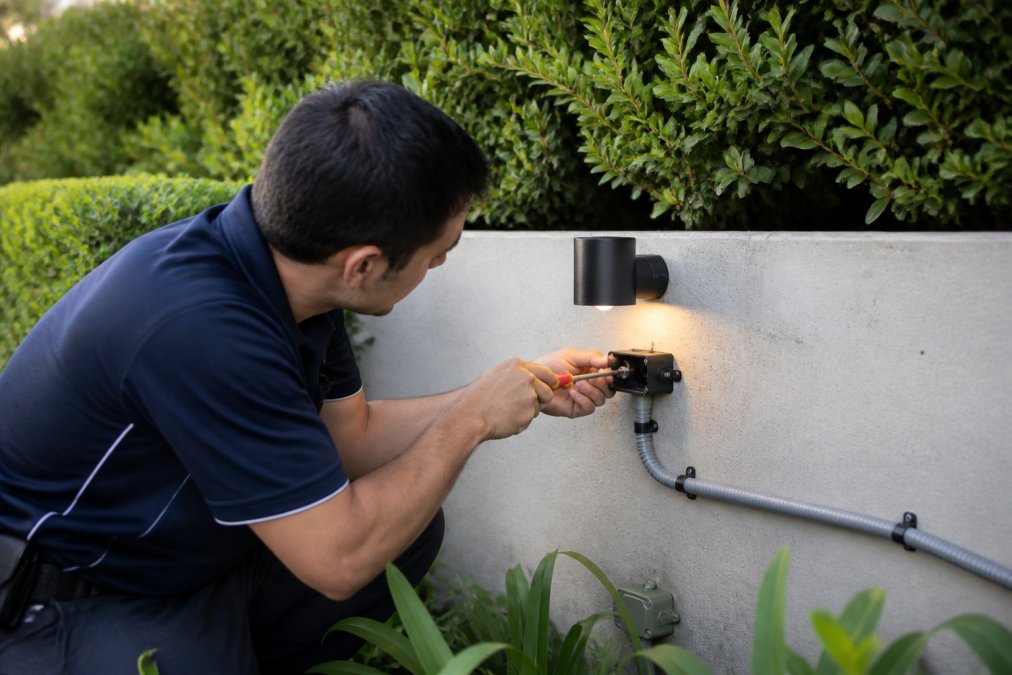
The installer tests each fixture as it’s installed, adjusts angles to eliminate unwanted light spill, and ensures all connections are secure. Professional installation includes a walkthrough explaining how to operate the system, adjust fixture angles if needed, and what maintenance is required.
Professional outdoor lighting installation transforms your garden into a functional, attractive outdoor space that’s safe and enjoyable after dark. The investment in proper design, quality fixtures, and professional installation pays dividends through reliable performance, lower energy costs, and genuine enjoyment of your outdoor areas.
WaterPro’s offers comprehensive garden lighting design, installation, and maintenance services tailored to your property’s specific needs. Our qualified technicians have three decades of experience installing systems that perform reliably in Melbourne’s climate. Book Now for a free design consultation and discover how professional outdoor lighting installation can enhance your home.
| Lighting Type | Primary Purpose | Typical Fixture | Best Placement |
|---|---|---|---|
| Pathway bollards | Safe navigation | 30-60 cm posts | Along walkways, 1-2 m apart |
| Step lights | Prevent trips at transitions | Recessed or surface-mount | On or beside steps |
| Accent lighting | Visual interest and drama | Spotlights or uplights | Below/behind features worth highlighting |
| Security lighting | Deter unwanted activity | Motion-activated or always-on | Entry points and dark corners |
| Ambient lighting | General atmosphere | Softer, distributed fixtures | Entertaining areas |
Frequently Asked Questions
Do I need a licensed electrician for outdoor lighting installation?
Yes. In Australia, outdoor lighting installations must comply with AS/NZS 3000 (the electrical safety standard). Any work involving mains voltage outdoor lighting requires a licensed electrician to ensure proper installation, grounding, and circuit protection. Even low voltage systems benefit from professional assessment to guarantee weatherproofing and long-term safety. A qualified electrician will verify IP ratings, transformer placement, and outdoor wiring meets regulatory requirements.
What IP rating do I need for outdoor lights?
IP ratings indicate protection against dust and water. For most garden lighting, IP65 is the standard minimum, protecting against water jets from any direction. Pathway bollards and deck step lights typically need IP67 for immersion protection. Fixtures in exposed locations or near water features should meet IP68. The first digit (6-8) shows dust protection; the second (4-8) shows water resistance. Your installer will recommend the right rating based on fixture location, climate exposure, and local weather patterns.
What factors affect outdoor lighting installation cost?
Several variables influence pricing: the number of fixtures, whether you need low voltage or mains voltage systems, transformer requirements, cable runs, existing infrastructure, site accessibility, and electrical compliance work. Smart lighting integration adds cost but offers automation benefits. Energy-efficient LED systems cost more upfront but reduce running costs significantly over time. A professional consultation provides a detailed breakdown tailored to your property's specific needs and design goals.
What are current trends in outdoor garden lighting?
Smart lighting automation dominates 2026 trends, with dusk-to-dawn sensors and app-controlled systems becoming standard. LED technology continues to improve efficiency and design flexibility. Homeowners increasingly favour warm colour temperatures for ambient lighting combined with accent lighting for architectural features. Sustainable design emphasises energy efficiency and reduced light pollution. Integrated water features with underwater lighting and landscape-integrated pathway systems are popular, along with customised lighting layouts that complement individual garden designs rather than generic installations.
This article was written using GrandRanker