
Table of Contents
- What Is Water Pump Short Cycling?
- Common Causes of Water Pump Short Cycling
- Diagnosing Water Pump Short Cycling with Pressure Gauge Readings
- Pressure Tank Waterlogged: Detection and Solutions
- Water Pump Pressure Switch Adjustment and Replacement
- Leaking Check Valve Symptoms and When to Replace
- Safety Protocols and When to Call a Professional
- Repair vs. Replacement: Cost-Benefit Considerations
Last Updated: August 16, 2026
What Is Water Pump Short Cycling?
Water pump short cycling occurs when your pump turns on and off far more frequently than it should. Instead of running for several minutes before shutting down, a short cycling pump may run for just 30 seconds to a minute, then restart almost immediately. This rapid on-and-off pattern strains the motor, wastes energy, and signals an underlying problem in your system.
The issue typically stems from pressure imbalances in your water system. When pressure drops too quickly after the pump shuts off, the pressure switch detects the drop and signals the pump to restart prematurely. Over time, this constant cycling accelerates wear on electrical contacts, bearings, and the motor itself, potentially cutting your pump’s lifespan significantly. The good news is that the cause is almost always identifiable, and many fixes are straightforward.
Common Causes of Water Pump Short Cycling
Short cycling rarely appears without a reason. The pump is responding to pressure signals, it’s just responding too often.
Faulty pressure switch
The pressure switch is the component that tells your pump when to start and stop based on system pressure. When this switch malfunctions, it can trigger the pump to restart before pressure has actually dropped enough to warrant it. Electrical contacts inside the switch can corrode or wear, creating false signals, or the switch may lose its calibration after years of use.
Testing the switch requires a multimeter and basic electrical knowledge. If you’re uncomfortable working with electrical components, this is a job worth handing to a qualified technician. Replacement switches are relatively inexpensive compared to the cost of a burned-out pump motor.
Waterlogged pressure tank
A waterlogged pressure tank is one of the most common causes of short cycling. Your pressure tank contains both water and air; the air acts as a cushion that allows pressure to stabilize between pump cycles. When water fills the tank beyond its proper level, the air charge becomes compressed or disappears entirely.
Without sufficient air space, pressure rises and falls rapidly. The pump reaches cut-out pressure almost instantly, then pressure drops just as quickly, triggering the pump to restart. You can check if your tank is waterlogged by tapping it. A fully waterlogged tank sounds hollow and dull, while a healthy tank with proper air charge produces a more resonant tone.
Loss of air charge in tank
Related to waterlogging, a loss of air charge in the pressure tank gradually reduces the tank’s ability to buffer pressure swings. The air inside the tank pre-charges it to a specific PSI (typically 2 PSI below your pump’s cut-in pressure). Over time, this air charge can leak away through small valve leaks, corrosion, or micro-fractures in the tank.
As the air charge diminishes, the tank’s cushioning effect weakens and the pump cycles more frequently to maintain system pressure. The fix involves draining the tank completely and re-pressurising it with a bicycle pump or compressor to the correct PSI. This maintenance is recommended every few years, depending on your system’s age and condition.
Blocked water lines or pipes
Restrictions in your water supply lines force the pump to work harder to deliver water. When lines are partially clogged from sediment, mineral deposits, or debris, the pump struggles to maintain adequate flow, triggering pressure fluctuations that confuse the pressure switch. A blocked line might also prevent water from reaching the pressure tank properly, causing the pump to cycle more often trying to reach the set pressure threshold.
Check for blockages by inspecting visible pipe sections for discolouration, mineral buildup, or kinks. If you suspect a clog deeper in the system, a qualified technician can flush the lines or use pressure testing to identify the exact location.
Leaking plumbing fixtures
Even a small leak, a dripping tap, a running toilet, or a pinhole leak in buried irrigation lines, causes constant pressure loss. Your pump detects this gradual pressure drop and restarts to compensate. If the leak is significant enough, the pump never gets a proper rest period.
Leaking fixtures are often the easiest problem to spot. Listen for water running when no taps are open, check for visible wet patches in your garden, or monitor your water meter for unexplained usage.
Diagnosing Water Pump Short Cycling with Pressure Gauge Readings
Accurate diagnosis requires understanding what your pressure gauge is telling you. A pressure gauge installed on your system provides real-time data about system pressure, and interpreting its behaviour during cycling reveals the underlying problem.
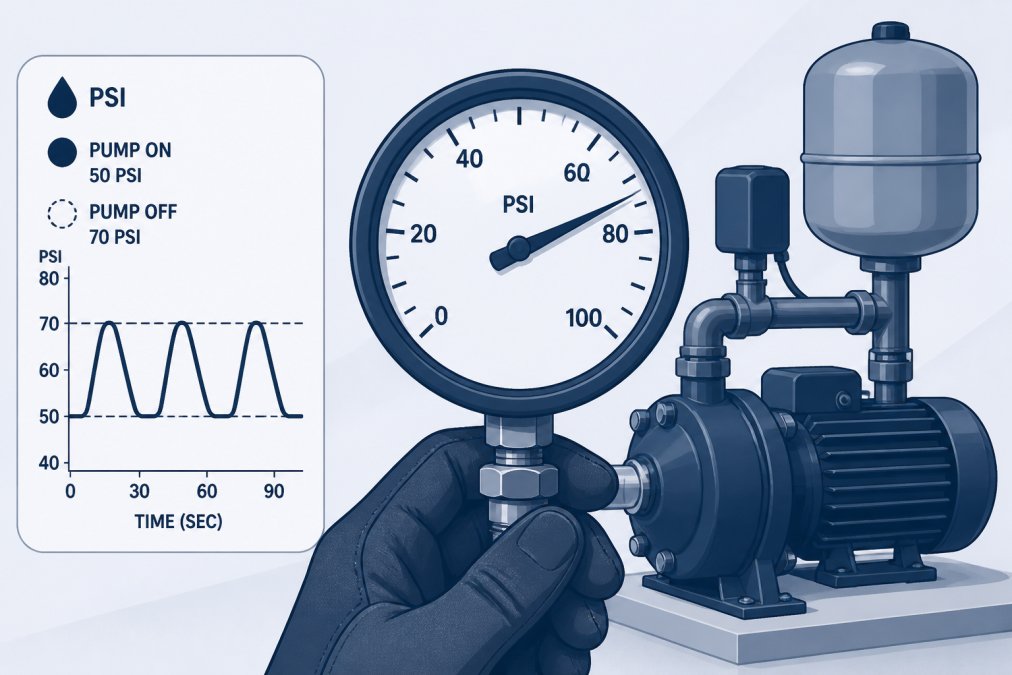
Normal operation follows a predictable pattern. Your pump runs until pressure reaches cut-out pressure (typically 60 PSI), then shuts off. Pressure remains stable while no water is being used. When you open a tap or your irrigation system activates, pressure drops gradually. Once it falls to cut-in pressure (typically 40 PSI), the pump restarts.
In a short cycling system, the gauge tells a different story. After the pump shuts off at cut-out pressure, the gauge needle drops rapidly, sometimes within seconds. If the needle drops to cut-in pressure within 30 seconds or less, your system is short cycling. Observe the gauge for several complete pump cycles and note the cut-in and cut-out pressures and how long the pump runs before shutting off.
A healthy system shows the pump running for 2-5 minutes before reaching cut-out pressure, with pressure remaining stable for 10-30 minutes or longer afterward. If your readings deviate significantly from this pattern, the pressure gauge readings themselves point toward the cause.
Pressure Tank Waterlogged: Detection and Solutions
Pressure tank waterlogged conditions are among the most straightforward problems to identify and fix. A waterlogged tank has lost its air charge, meaning water has expanded to fill most or all of the tank’s interior volume.
To confirm waterlogging, turn off your pump and open the lowest tap in your system to drain water. If water flows continuously for more than a few minutes before air enters the line, your tank is waterlogged. A healthy tank releases water for only 10-20 seconds before air enters.
The solution requires draining the tank completely and re-pressurising it. First, shut off the pump and open all taps to release pressure. Then, use a ball valve or drain plug (usually located at the tank’s base) to empty it entirely. Once empty, use a bicycle pump or air compressor to pressurise the tank to approximately 2 PSI below your pump’s cut-in pressure. If your cut-in is 40 PSI, pre-charge the tank to about 38 PSI.
This maintenance task should be repeated every 2-3 years, or whenever you notice short cycling returning. WaterPro’s technicians can assess your tank’s condition and perform this service as part of routine maintenance.
Water Pump Pressure Switch Adjustment and Replacement
The water pump pressure switch adjustment process allows you to fine-tune when your pump starts and stops. However, adjustment is only effective if the switch itself is functioning properly.
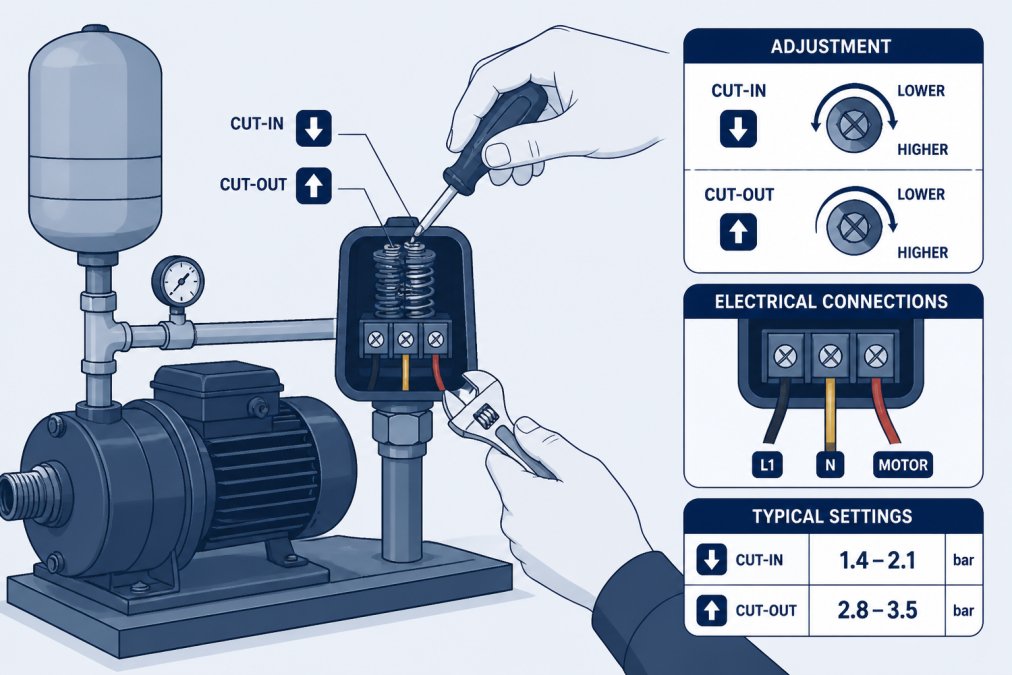
Before attempting adjustment, confirm that your switch is the problem by ruling out other causes. If your tank is properly charged, lines are clear, and no leaks exist, but short cycling persists, the switch is likely faulty.
To adjust a pressure switch, locate the adjustment nuts or screws on the switch housing (usually on top). Turning the main adjustment nut clockwise increases both pressures; counterclockwise decreases them. Make small adjustments, typically a quarter turn, then test the system. Allow several pump cycles before making additional changes.
If adjustment doesn’t resolve short cycling, or if the switch appears corroded or damaged, replacement is necessary. Pressure switches are relatively inexpensive components, typically costing far less than emergency pump repairs. For systems with complex electrical configurations, professional installation ensures the new switch is wired correctly and calibrated to your system’s specifications.
Leaking Check Valve Symptoms and When to Replace
A check valve allows water to flow in one direction only, preventing backflow when the pump shuts off. When a check valve leaks, water flows backward through the pump after it stops, causing pressure to drop rapidly and triggering short cycling.
Leaking check valve symptoms include rapid pressure drop immediately after the pump shuts off, and the pump restarting within seconds. You might also hear a distinctive "thunk" or water hammer sound when the pump shuts off.
To test a check valve, install a pressure gauge on the discharge line. Note the pressure when the pump is running, then turn off the pump and watch the gauge. If pressure drops more than a few PSI within one minute, the check valve is leaking.
Replacing a check valve requires shutting off the pump and releasing system pressure. The valve is typically located on the discharge line near the pump. Disconnect the old valve using a wrench, then install the new one, ensuring the flow direction arrow on the valve body points away from the pump. Check valves should be inspected annually and replaced if they show signs of corrosion, pitting, or leakage.
Safety Protocols and When to Call a Professional
Working on pressurised water systems carries genuine risks. Always shut off the pump and release system pressure before disconnecting any component. Open the lowest tap in your system and let water drain completely. Wear safety glasses when opening tank valves or connections.
Never work on electrical components unless you’re confident in your abilities. Pressure switches, pump motors, and wiring carry electrical hazard. When working with pressurised tanks, be aware that over-pressurisation can cause tank failure or rupture. Use a pressure gauge when re-charging tanks with air, and never exceed the tank’s rated pressure.
Call a professional technician if you’re uncomfortable working with electrical components, cannot identify the cause of short cycling after basic troubleshooting, the pump is making unusual noises or showing signs of overheating, you’ve attempted repairs and the problem persists, or your system is more than 15-20 years old and may need replacement assessment.
WaterPro’s technicians are trained to diagnose complex short cycling issues safely and efficiently. Our qualified team can often identify and resolve short cycling within a single service visit.
Repair vs. Replacement: Cost-Benefit Considerations
Deciding whether to repair or replace a short cycling pump depends on the pump’s age, the cost of repairs, and your system’s overall condition.
Most short cycling problems are resolved through inexpensive fixes: replacing a pressure switch, re-pressurising a tank, or repairing a leaking fixture. These repairs usually cost significantly less than a new pump and restore normal operation immediately.
However, if your pump is older than 15-20 years, short cycling may signal that the entire system is nearing the end of its lifespan. Consider replacement if the pump is 20+ years old, repairs are needed frequently (more than once per year), the pump shows signs of rust, corrosion, or noise, your water pressure or flow is consistently inadequate, or the cost of repair approaches 50% or more of a new pump’s price.
A new pump offers improved efficiency, better pressure regulation, and modern features like soft-start technology that reduces electrical stress. Over its 15-20 year lifespan, a new pump often proves more economical than repeated repairs to an aging system.
WaterPro’s can assess your system’s age and condition, estimate repair costs, and provide quotations for replacement if needed.
Short cycling is frustrating, but it’s also one of the most solvable pump problems. Most cases stem from pressure tank issues, faulty switches, or simple leaks, all of which have straightforward fixes. Start by checking your pressure gauge readings and ruling out waterlogging and leaks. If you’re uncertain about diagnosis or repair, WaterPro’s offers professional diagnostic services and can handle repairs or replacement. Book a consultation with our team to get your system running smoothly again and eliminate the constant cycling that’s wearing out your pump.
Frequently Asked Questions
How can I fix my water pump that is short cycling?
The fix depends on the cause. Start by checking your pressure tank for waterlogging and verifying the air charge with a pressure gauge. If the tank reads below 0.7 MPa, it needs re-pressurisation. Check your pressure switch settings, most systems should cut in at 1.7-2.1 MPa and cut out at 2.8-3.4 MPa. Inspect for leaking fixtures, clogged pipes, and a faulty check valve. If these steps don't resolve the issue, the pressure switch or pump motor may need professional replacement.
What is the most common cause of water pump short cycling?
A waterlogged pressure tank is the leading cause. When the diaphragm inside the tank fails or the air charge depletes, the tank loses its ability to absorb pressure spikes. This forces the pump to cycle constantly to maintain system pressure. The second most common cause is a faulty pressure switch that triggers the pump to start and stop at incorrect PSI levels. Both require diagnosis with a pressure gauge and professional repair.
How do I check the pressure tank air pressure?
Turn off the pump and drain the system completely. Locate the air valve on top of the pressure tank, it resembles a car tyre valve. Use a pressure gauge to read the current PSI. A healthy tank should hold 0.7 MPa (approximately 7 bar) with the system empty. If the reading is zero or very low, the diaphragm has failed and the tank needs replacement. If it's between 0.5-0.7 MPa, you may be able to re-pressurise it using a compressor, but professional inspection is recommended first.
Is short cycling bad for a water pump?
Yes. Short cycling significantly reduces pump lifespan by causing the motor to start and stop excessively, which generates heat and electrical stress. Frequent starts also increase amperage demand on the motor, leading to premature wear of the thermal overload protection and electrical contacts. Over time, this creates water hammer effects in the pipes and can damage check valves and other system components. Addressing the root cause immediately prevents costly repairs and extends the life of your entire water supply system.
This article was written using GrandRanker