

Table of Contents
- What Causes Uneven Lawn Growth
- How to Identify the Root Cause of Your Patchy Lawn
- Step 1: Aeration and Its Benefits for Lawn Health
- Step 2: Dethatching to Remove Debris and Improve Seed-to-Soil Contact
- Step 3: Lawn Top Dressing Techniques for Surface Levelling
- Step 4: Overseeding and Establishing Uniform Turf Density
- Irrigation System Maintenance to Prevent Future Unevenness
- Common Mistakes to Avoid When Fixing Uneven Lawn Growth
Last Updated: August 23, 2026
What Causes Uneven Lawn Growth
Uneven lawn growth frustrates most homeowners because the causes run deeper than surface-level problems. Understanding what’s really happening beneath your grass is the first step to fixing it properly.
Soil compaction and poor drainage sit at the root of many patchy lawns. When soil becomes compacted, water struggles to penetrate, roots can’t develop properly, and grass struggles to establish uniform growth. Compacted soil prevents the root zone from expanding naturally, leaving shallow roots that can’t access nutrients or moisture consistently across your lawn. Heavy foot traffic, repeated mowing over the same paths, and equipment use all contribute to this problem.
Thatch layer buildup creates another barrier between your grass and the nutrients it needs. Thatch is the accumulation of dead grass clippings, roots, and organic matter that sits just above the soil surface. A thin thatch layer (under 12 millimetres) actually protects your lawn, but excessive thatch blocks water, air, and nutrients from reaching the soil (peer-reviewed research). This causes uneven germination when you overseed and prevents existing grass from developing uniform turf density.
Irrigation uniformity problems are often overlooked but incredibly common. If your irrigation system delivers water unevenly across the lawn, some areas stay waterlogged while others dry out between waterings. This creates the perfect conditions for patchy growth, some spots thrive while adjacent areas struggle. Broken sprinkler heads, misaligned nozzles, and poor system design all disrupt the consistency your grass needs.
How to Identify the Root Cause of Your Patchy Lawn
Diagnosing the real problem saves you time and money. Most people start fixing without understanding what went wrong, which means they address symptoms rather than causes.
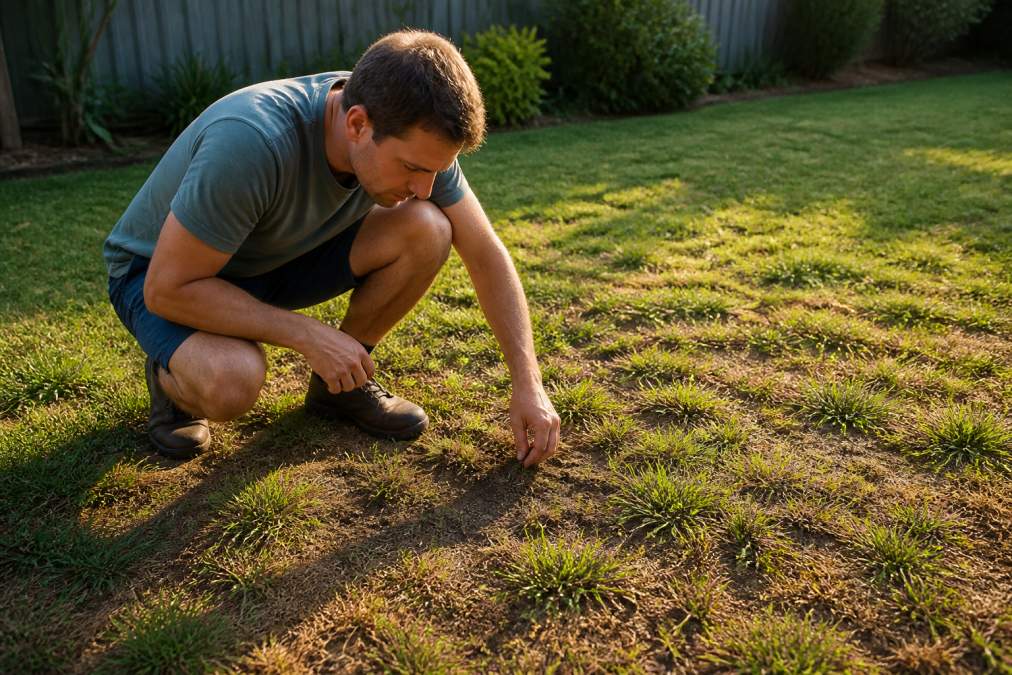
Visual inspection techniques reveal what’s happening on the surface. Walk your entire lawn and note where growth is uneven. Are the bare patches concentrated in high-traffic areas? That suggests soil compaction. Do they appear randomly scattered? Look for irrigation coverage issues. Check grass height, if mower blades are scalping certain areas while others stay taller, your lawn surface itself is uneven and needs levelling.
Press down firmly on different spots with your heel. Compacted soil resists pressure and feels hard; healthy soil gives slightly. Look for visible thatch, if you pull back the grass gently and see a thick brown mat of dead material, excessive thatch buildup is your problem. Examine the colour and vigour of growth. Nutrient deficiency shows as pale or yellowing patches, while poor drainage appears as darker, soggy areas even days after rain.
Soil testing and pH assessment give you concrete data. A soil test reveals nutrient levels, organic matter content, and soil structure, information you can’t get from visual inspection alone. Many Australian soils lean acidic, which affects nutrient availability. Grass species perform best within specific pH ranges, typically 6.0-7.0 for cool-season grasses (extension.oregonstate.edu). Testing also identifies whether your soil is predominantly clay, sandy loam, or loam, which affects how you’ll approach top-dressing and amendment.
Contact your local agricultural extension service or use a commercial soil testing kit. Results typically arrive within two weeks and provide specific recommendations for amendments. This data becomes essential when choosing your top-dressing mix and understanding whether nutrient deficiency is contributing to your uneven growth.
Step 1: Aeration and Its Benefits for Lawn Health
Aeration is the single most effective treatment for soil compaction. It’s not optional if your lawn has compacted soil, it’s foundational.
Why aeration reduces soil compaction comes down to physics. Aeration removes small cores of soil from your lawn, creating channels that allow air, water, and nutrients to penetrate deeper into the root zone. These channels relieve pressure on compacted soil and encourage roots to grow deeper and spread more widely. Deeper roots access more consistent moisture and nutrients, which translates directly into more uniform grass growth.
The process also stimulates microbial activity in the soil. Beneficial organisms thrive when oxygen becomes available, which improves soil structure naturally over time. After aeration, your lawn recovers faster from stress and establishes new growth more vigorously.
Equipment rental vs. DIY tools depends on your lawn size and budget. For small suburban blocks under 500 square metres, a manual spike aerator or a borrowed core aerator often works fine. Spike aerators punch holes but don’t remove soil, making them less effective than core aeration. Core aerators pull out soil plugs, which is superior but requires either renting equipment or hiring a contractor.
Rental aerators cost between $40-80 for a half-day hire from most equipment rental outlets. Hiring a contractor typically costs more upfront but saves physical labour and ensures professional coverage. WaterPro’s can assess your lawn’s compaction level and recommend whether DIY aeration makes sense for your property or whether professional treatment delivers better results.
Best timing for aeration varies by grass type and climate. For cool-season grasses common in southern regions, autumn (March to May) and spring (September to November) are ideal, grass recovers quickly during these growing seasons. Avoid summer and winter aeration when grass is stressed or dormant. Aerate when soil is moist but not waterlogged; the soil should hold together slightly when squeezed but crumble easily.
Step 2: Dethatching to Remove Debris and Improve Seed-to-Soil Contact
Once you’ve relieved soil compaction through aeration, dethatching removes the barrier that’s been blocking water and nutrient penetration.
Recognising excessive thatch buildup is straightforward. Pull back the grass gently and look at the layer between green shoots and soil. If you see more than 12 millimetres of brown, fibrous material, dethatching is necessary. Thatch accumulates when dead grass clippings, roots, and organic matter break down slower than they’re being added. Lawns that receive heavy nitrogen fertilisation without regular maintenance tend to develop thick thatch quickly.
Excessive thatch also feels spongy underfoot, your lawn bounces slightly when you walk on it rather than feeling firm. This spongy feel indicates poor seed-to-soil contact, which becomes critical when you overseed to establish uniform turf density.
Dethatching techniques and timing require the right approach. A dethatcher (also called a power rake) has rotating blades that comb out dead material. For small lawns, a manual dethatcher works, though it’s labour-intensive. For larger properties, renting a power dethatcher saves significant time. Run the machine in one direction, then perpendicular to create a crosshatch pattern. This pulls out more thatch and loosens compacted material.
Dethatch in autumn or early spring when grass is actively growing and can recover quickly. Never dethatch during summer stress or winter dormancy. After dethatching, you’ll see a mess of dead material on your lawn, rake it up thoroughly. This debris removal is essential; leaving it blocks water and air from reaching the soil.
Step 3: Lawn Top Dressing Techniques for Surface Levelling
Top-dressing fills low spots and creates a level surface where seed can make proper contact with soil. This step directly addresses the uneven surface that causes patchy growth.
Choosing the right soil mix and sandy loam matters more than most people realise. A quality top-dressing mix should contain sandy loam, a blend of sand, silt, and clay with organic matter. Sandy loam provides good drainage while retaining enough moisture and nutrients to support germination. Avoid pure sand (drains too fast) and pure clay (compacts and drains poorly).
Look for top-dressing mixes specifically formulated for lawn repair. These typically contain 50-70% sand, 20-30% silt and clay, and 10-20% organic matter. The organic matter improves water retention and provides slow-release nutrients. If you’re amending a naturally acidic soil, choose a mix with pH-adjusted components or add lime separately.
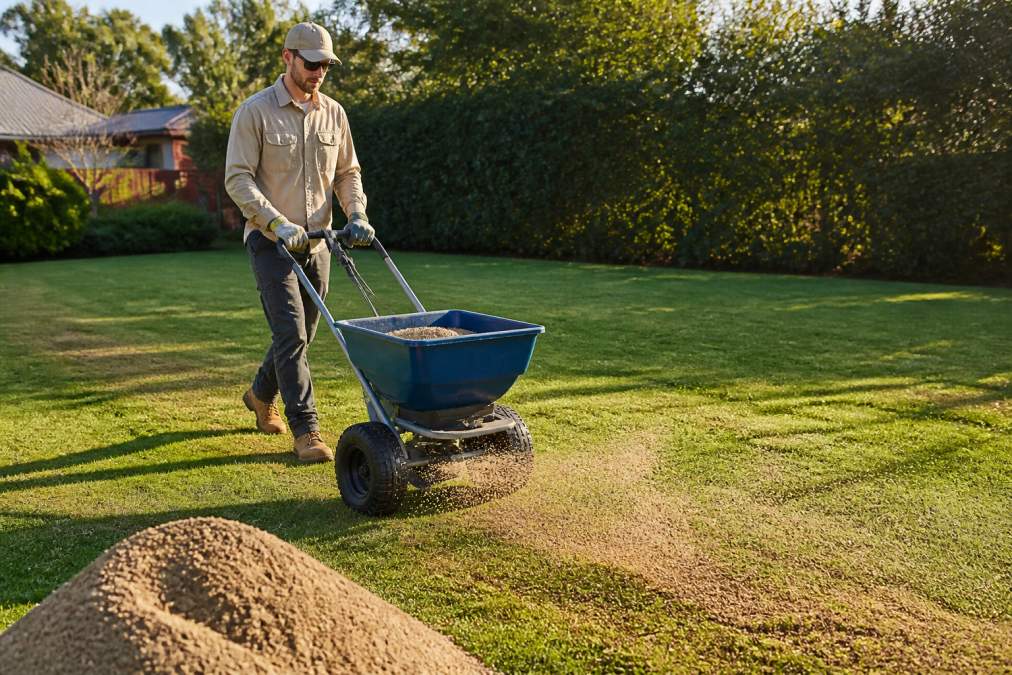
Application rates and timing determine whether top-dressing actually levels your lawn or just adds a thin, ineffective layer. For general levelling, apply 6-12 millimetres of top-dressing material (peer-reviewed research). For severely uneven lawns, you may need two applications a few weeks apart. Spread the material evenly across the entire lawn, not just problem areas, this creates uniform soil conditions that support consistent growth.
Apply top-dressing in early spring or autumn when grass is growing actively. Water thoroughly after application so the material settles into low spots and makes contact with the soil. Avoid top-dressing during hot, dry periods when the new material won’t integrate properly.
Step 4: Overseeding and Establishing Uniform Turf Density
Overseeding fills in bare patches and thickens sparse areas. Combined with aeration, dethatching, and top-dressing, overseeding transforms patchy lawns into uniform turf.
Seed selection for your grass species requires matching grass type to your climate and lawn conditions. Cool-season grasses like perennial ryegrass and tall fescue suit southern regions. Warm-season varieties perform better in northern areas. Check your existing grass type, you’ll want to overseed with the same species to maintain consistency.
Choose certified seed with high germination rates. Look at the seed label for germination percentage (aim for 85% or higher) and purity (95% or higher). Avoid cheap seed blends with excessive filler, they germinate poorly and introduce weeds.
Germination and establishment care requires consistent moisture for 2-3 weeks after seeding. Water lightly but frequently, the top 25 millimetres of soil should stay moist but not waterlogged. Once seedlings emerge and establish their first true leaves, gradually reduce watering frequency while increasing depth. This encourages deeper root development.
Don’t mow newly seeded areas until grass reaches 50 millimetres height. Keep foot traffic minimal during the establishment phase. Germination typically takes 7-14 days depending on temperature and moisture. Full establishment of uniform turf density takes 6-8 weeks.
Irrigation System Maintenance to Prevent Future Unevenness
Your irrigation system is only effective if it delivers water uniformly across your entire lawn. Maintenance prevents the uneven growth problems that develop from inconsistent coverage.
Checking irrigation uniformity and coverage reveals whether your system is working as designed. Run your system and observe where water lands. Look for dry spots, overwatered areas, and misaligned sprinkler heads. Place collection containers (like small cups or cans) at various points across your lawn and run the system for 15 minutes. Measure water depth in each container, variation greater than 25% indicates uniformity problems.
Inspect sprinkler heads for damage, clogs, and proper nozzle orientation. Debris clogs nozzles and creates dry spots. Misaligned heads waste water and leave gaps in coverage. Clean heads carefully and adjust angles to ensure even distribution. Replace damaged or worn heads, they’re inexpensive and make a significant difference.
Seasonal adjustments and system checks keep your irrigation system performing consistently. In summer, increase watering frequency and duration as temperatures rise and evaporation increases. In autumn and winter, reduce watering as rainfall increases and grass growth slows. Check your system before each season, look for leaks, damaged pipes, and controller programming errors.
Most modern irrigation systems allow zone-based adjustments. If certain lawn areas dry faster than others, adjust those zones independently rather than overwatering the entire lawn. WaterPro’s can evaluate your system’s efficiency and recommend adjustments that deliver uniform coverage while minimising water waste.
Common Mistakes to Avoid When Fixing Uneven Lawn Growth
Most people make the same errors when attempting to repair patchy lawns. Learning from these mistakes saves time and prevents wasted effort.
Skipping soil testing is the biggest mistake. People assume they know what’s wrong and start treating without understanding the actual problem. Soil testing reveals nutrient deficiencies, pH issues, and soil structure problems that visual inspection can’t identify. Without this information, you might overseed a lawn with poor drainage and watch the new seed fail.
Overseeding without preparation wastes seed and money. Overseeding onto compacted soil, excessive thatch, or uneven surfaces produces poor germination and patchy results. Proper preparation, aeration, dethatching, top-dressing, and levelling, creates conditions where seed actually germinates and establishes uniformly.
Applying too little top-dressing leaves low spots unfilled. Many people spread a thin layer thinking they’re saving money, but thin applications settle unevenly and don’t level the surface properly. Apply sufficient material to actually fill low spots, 6-12 millimetres across the entire lawn is the minimum for meaningful results.
Ignoring irrigation problems means uneven growth returns after you’ve fixed everything else. If your system delivers water inconsistently, some areas will always struggle. Check coverage uniformity and fix sprinkler issues before overseeding. Consistent irrigation is non-negotiable for maintaining uniform turf density long-term.
Dethatching at the wrong time stresses grass unnecessarily. Dethatch during active growing seasons (autumn or spring), not during summer heat or winter dormancy. Dethatching stressed grass weakens it further and slows recovery.
Fixing uneven lawn growth requires addressing soil compaction, excessive thatch, irrigation problems, and surface levelling systematically. The process takes time, typically 8-12 weeks from aeration through full establishment of new growth, but the results are dramatic. A properly levelled, consistently irrigated lawn with healthy soil supports uniform grass growth that looks professional and requires less maintenance long-term.
WaterPro’s has helped homeowners transform patchy lawns into uniform, healthy turf through professional aeration, system maintenance, and irrigation optimisation. Our qualified technicians can assess your specific situation, identify the root causes of your uneven growth, and recommend the most effective treatment plan for your property. Book Now with WaterPro’s to get a professional evaluation of your lawn and irrigation system, and discover how proper water management and soil preparation create the uniform, healthy lawn you’re aiming for.
Frequently Asked Questions
How can I flatten an uneven lawn myself?
Start by aerating your lawn to relieve soil compaction, which is often the root cause of unevenness. After aeration, apply a top-dressing of sandy loam in thin layers (about 6 mm at a time) across low areas. Overseed the treated areas and maintain consistent irrigation. For severe unevenness, you may need multiple applications over several months. Professional equipment rental can speed up the process if your lawn is large.
What causes patches of grass to grow faster than others?
Uneven growth typically stems from soil compaction, poor drainage, nutrient deficiency, or inconsistent irrigation coverage. Thatch layer buildup can also prevent water and nutrients from reaching the root zone. Soil pH imbalances and shallow roots caused by compacted soil further restrict growth. A soil test reveals nutrient and pH issues, while visual inspection helps identify drainage problems and irrigation gaps.
When is the best time to top-dress a lawn?
Top-dress during your lawn's active growing season, typically spring or early autumn, when grass can recover quickly. Avoid top-dressing in summer heat or winter dormancy. Apply in thin layers (6 mm or less) to avoid smothering grass, and water thoroughly after application to help the mix settle and integrate with existing soil. Combine top-dressing with aeration and overseeding for best results.
Can I level a lawn myself, or do I need professional help?
Minor unevenness (under 25 mm) is manageable with DIY aeration, top-dressing, and overseeding over several months. Severe bumps or hollows may require professional equipment or multiple treatments. If your lawn has drainage issues, irrigation problems, or persistent compaction, a qualified technician can diagnose the underlying cause and recommend the most effective repair strategy, saving time and ensuring lasting results.
This article was written using GrandRanker